By Charlie Sichel, managing partner, FLS
This article first appeared in The Alternative Investor.
The UN’s 2004 Who Cares Wins report is widely credited with bringing ESG into the mainstream, spreading the gospel that investors could make money while saving the planet. The idea that green investing and profitability went hand in hand took hold.
But as sustainable investing turns 21, that narrative is evolving. Sustainable funds are struggling with lacklustre performance and investor outflows, while fossil fuels remain the world’s leading source of energy. The prediction that saving the planet will automatically maximise profits has proven overly simplistic. Like many 20-somethings, the sustainable investing movement is letting go of ideological purity and embracing a more pragmatic view of how to make money morally.
Every investment involves trade-offs, with forestry no exception. The next chapter in forestry is about navigating these choices—balancing financial returns with carbon sequestration, biodiversity, and social impact. By doing so, we can create a truly sustainable long-term investment.
Trees, one of our best tools in the fight against climate change, only capture significant carbon while they’re growing. That’s the rationale behind greenfield monocultures—large-scale, from-scratch plantations that are profitable, create jobs, and indirectly reduce deforestation pressure on older forests. However, there’s a catch: when poorly structured, monocultures contribute little to biodiversity. While they deliver in terms of carbon capture and financial returns, they lack the ecological benefits of natural forests.
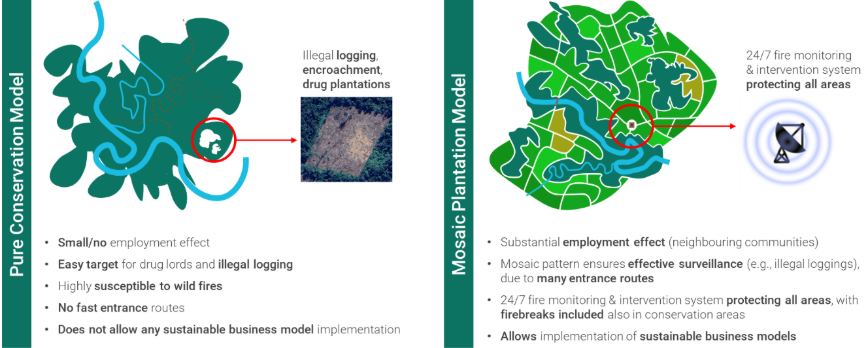
So, what’s the solution? A more balanced approach in the form of ‘mosaic forestry’. This model integrates commercial timber operations, conservation efforts, and local engagement into a unified framework. It’s about finding equilibrium, securing long-term revenue streams while enhancing biodiversity and supporting local communities. This lays the groundwork for long-term project stability and for use of a better word, it establishes a more sustainable model.
The design of a mosaic forest typically preserves or establishes conservation (or riparian) corridors where fauna can co-exist within commercial plantations, thereby actively supporting biodiversity. When this is carried out in neglected pasturelands with degraded soils, then the positive impact can be substantial.
Combining commercial and conservation efforts can create valuable operational synergies which protect natural forests from threats like wildfires and illegal logging. The commercial part enables firebreaks, establishes sophisticated monitoring protocols, and instils regular intervention, while also delivering long-lasting social benefits, such as job creation and cyclical replanting of harvested wood.
At a time staying below 1.5 degrees1 look increasingly unattainable, and there is a supply deficit of wood requiring up to USD4.5 trillion by 20502, there would seem the makings of a perfect trade-off.
In greenfield mosaic afforestation, there is a pragmatic way to blend financial returns with carbon sequestration, biodiversity, and social impact. Only by combining all of these, can we create a truly sustainable investment.
Forestry Linked Securities (FLS®) is a capital markets platform that develops and structures forestry investments for capital market investors, offering attractive returns, carbon sequestration, and best-in-class analytics and reporting.